

When Business Excellence Becomes “Yesterday’s Strategy” — And Why That’s a Leadership Failure, Not a Methodology Problem
I’ve seen this pattern play out more times than I care to admit.
A forward-thinking founder or CEO champions operational excellence. There’s conviction. There’s intent. Sometimes, there’s even a philosophical alignment with systems thinking — call it Lean, call it Six Sigma, call it continuous improvement.
A few pilot cohorts are launched.
They deliver.
Not vanity metrics — real outcomes. Reduced cycle times. Improved cash flows. Better customer experience. Tangible P&L impact.
For a brief moment, it works exactly as it should.
And then… it fades.
Not abruptly. Not dramatically. But quietly. Systematically. Almost predictably.
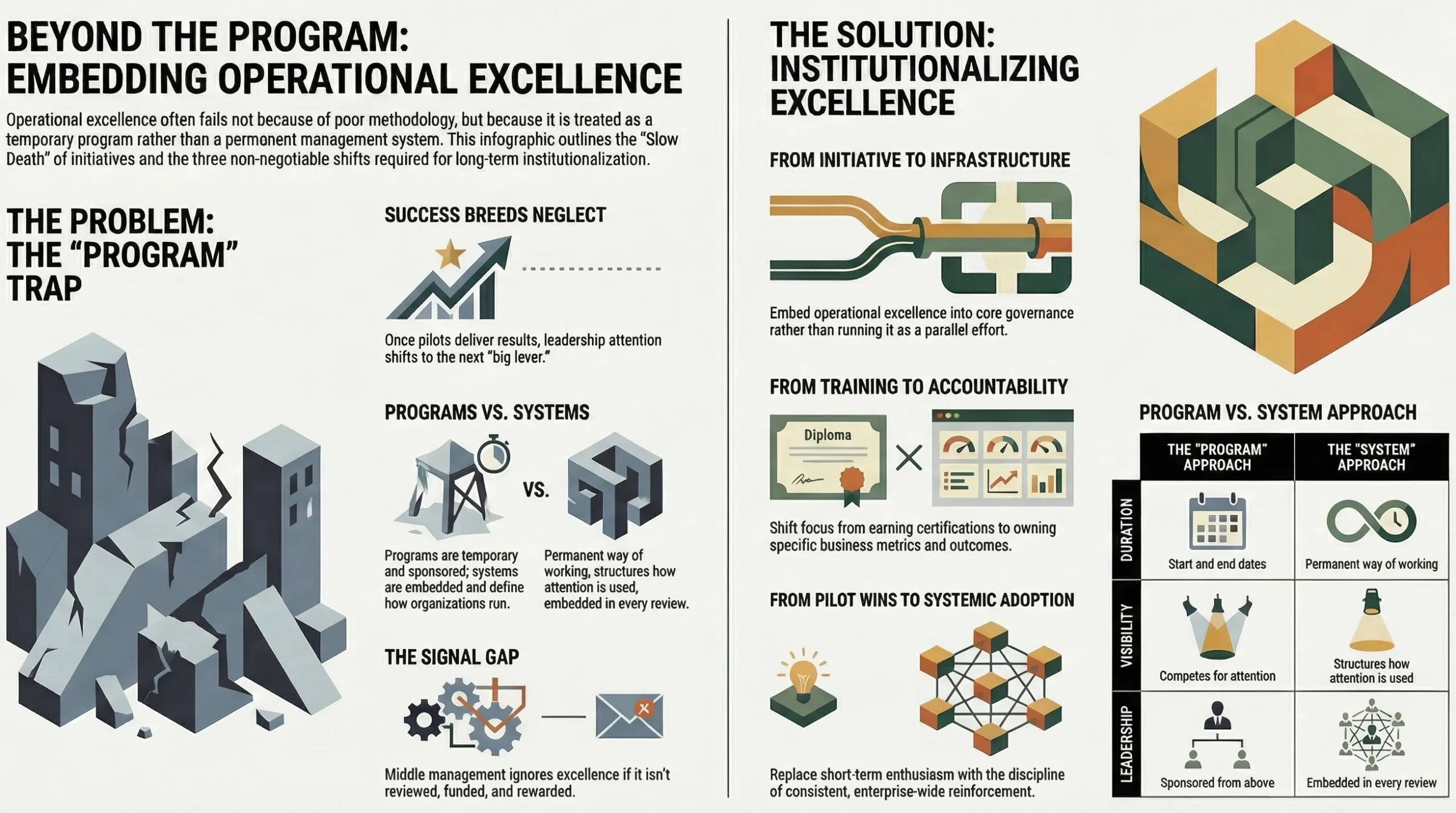
The Slow Death Nobody Talks About
What kills operational excellence in most organisations is not failure.
It’s success — followed by neglect.
Once the initial wave of enthusiasm passes, leadership attention shifts. Strategy reviews. M&A opportunities. New market entries. AI initiatives. The next “big lever.”
Operational excellence, ironically, becomes a victim of its own positioning — seen as something tactical, something that can “run in the background.”
Middle management reads the signal clearly.
And they respond accordingly.
Not out of incompetence, but rational alignment.
They chase what leadership visibly prioritises.
Because in most organisations, priorities are not what is said — they are what is reviewed, funded, and rewarded.
The Real Problem: Misclassification
Here’s the core issue:
Operational excellence is treated as a program.
When it should be treated as a management system.
Programs have start dates and end dates.
Management systems define how an organisation runs.
Programs are sponsored.
Systems are embedded.
Programs compete for attention.
Systems are the way attention is structured.
When Lean or Six Sigma is deployed as a program, it is inherently temporary. It becomes vulnerable to leadership bandwidth, budget cycles, and shifting narratives.
And eventually, it loses.
The CXO Blind Spot
At the CXO level, there’s often an implicit assumption:
“If it worked, it will sustain.”
That assumption is flawed.
Operational excellence does not sustain itself.
It requires:
- Governance that is tied to business reviews
- Metrics that show up in leadership dashboards
- Incentives that reward problem-solving, not firefighting
- Capability building that goes beyond certification into application
Without this, even the most successful pilots remain isolated pockets of excellence — not enterprise capability.
Why Middle Management Gets Blamed (Unfairly)
It’s easy to say:
“Middle management didn’t drive it.”
But let’s be honest.
Middle management is structurally conditioned to optimise for visibility and survival.
If operational excellence is not part of performance scorecards, not discussed in monthly reviews, and not linked to career progression — it will never become a priority.
Not because they don’t believe in it.
But because the system doesn’t require them to.
The Hard Truth
Operational excellence doesn’t fail because it’s outdated.
It fails because organisations lack the discipline to institutionalise it.
In today’s environment — where margins are under pressure, customer expectations are rising, and complexity is exploding — the need for structured problem-solving is higher than ever.
If anything, the relevance of Lean and Six Sigma has increased.
What hasn’t kept pace is how organisations deploy it.
What Needs to Change
If leadership teams are serious about making operational excellence stick, three shifts are non-negotiable:
- From Initiative to Infrastructure
Operational excellence must be embedded into how work is governed — not run as a parallel effort.
- From Training to Accountability
Certifications don’t drive outcomes. Ownership does. Every project must tie back to a business metric that someone is accountable for.
- From Short-Term Wins to Systemic Adoption
Pilot success is not the goal. Enterprise-wide adoption is. That requires patience, reinforcement, and visible leadership commitment.
A Final Reflection
Every organisation wants the outcomes of operational excellence.
Faster execution. Lower costs. Better quality. Predictable delivery.
But very few are willing to do what it takes to sustain it.
Because sustaining it requires something far less glamorous than strategy decks and acquisitions.
It requires consistency.
And consistency, in most organisations, is in short supply.
If you’ve seen this pattern play out in your organisation, you’re not alone.
The question is not whether operational excellence works.
The question is whether we are willing to treat it as seriously as the outcomes we expect from it.
— Ramesh Gopalan (Magnum One)