

The AI Adoption Trap: How Organisations Are Deploying Innovation Without Governance
Over the past year, I’ve had a front-row seat to how organisations are embracing AI. Boardrooms are energised, leadership teams are curious, and there’s a palpable urgency to “do something with AI.”
But beneath this enthusiasm, I’ve also observed a pattern—one that concerns me.
Organisations are moving fast… sometimes too fast.
They are adopting AI without the scaffolding needed to sustain it.
And that’s what I call the AI Adoption Trap.
The Rush to Innovate
In many conversations I’ve had with CXOs, the narrative is strikingly similar:
- “We need AI embedded into our processes.”
- “Our competitors are already doing this.”
- “Let’s pilot something quickly.”
There’s nothing inherently wrong with speed. In fact, in today’s environment, speed is a competitive advantage.
But speed without structure?
That’s where the problem begins.
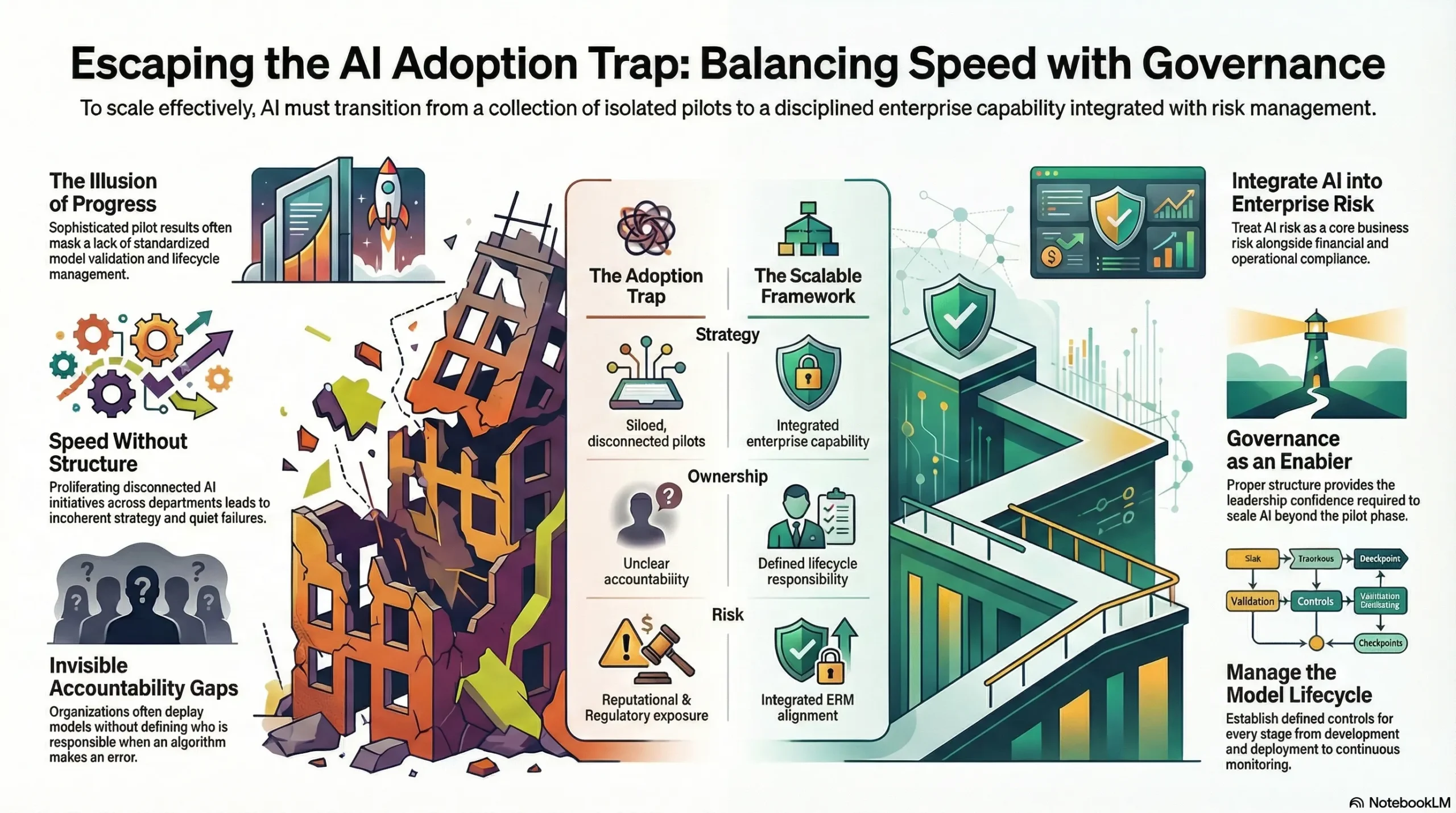
What I often see is a proliferation of disconnected initiatives:
- A chatbot deployed in customer service
- A predictive model built in operations
- An AI-enabled dashboard in finance
Each initiative, in isolation, looks impressive. Collectively, however, they lack coherence.
The Invisible Risks No One Talks About
AI doesn’t fail loudly at first. It fails quietly.
And that’s what makes the risks dangerous.
From my experience, organisations tend to underestimate three critical areas:
1. Accountability Gaps
Who owns the AI decision?
When an algorithm makes a recommendation—or worse, an error—who is responsible?
In many cases, there is no clear answer.
2. Data Integrity Risks
AI models are only as good as the data they consume.
Yet, I’ve seen organisations deploy models without robust data governance, leading to decisions built on shaky foundations.
3. Ethical and Regulatory Exposure
Bias, explain ability, and compliance are not theoretical concerns anymore.
They are real, and regulators are catching up faster than many organisations anticipate.
The Illusion of Progress
One of the most interesting dynamics I’ve noticed is what I call the **illusion of progress**.
Dashboards look sophisticated.
Pilot results appear promising.
Internal demos generate excitement.
But when you peel back the layers, you often find:
- No standardised model validation framework
- No lifecycle management for AI models
- No integration with enterprise risk management
In other words, innovation is happening—but governance is not keeping pace.
Why Governance Feels Like a Constraint (But Isn’t)
There’s a common misconception that governance slows things down.
In reality, the absence of governance slows things down *later*—often in far more painful ways.
Projects get stalled.
Models get scrapped.
Reputational risks emerge.
Good governance, when designed correctly, does not act as a barrier.
It acts as an enabler.
It provides:
- Clarity on ownership
- Consistency in deployment
- Confidence for leadership to scale AI initiatives
What Organisations Should Be Doing Differently
Based on what I’ve seen working across industries, a few principles stand out.
1. Treat AI as an Enterprise Capability, Not a Set of Pilots
AI should not live in silos.
It needs to be embedded within the broader operating model.
2. Integrate AI Governance into ERM Frameworks
AI risk is business risk.
It should sit alongside financial, operational, and compliance risks—not outside them.
3. Establish Clear Model Lifecycle Management
From development to deployment to monitoring—every stage needs defined controls and ownership.
4. Focus on Explain ability and Trust
If leadership cannot understand how a model arrives at its outputs, scaling that model becomes a risk in itself.
A Personal Reflection
As someone who has spent years working on operational excellence and risk frameworks, I find this moment fascinating.
We are at the intersection of two powerful forces:
- The drive to innovate
- The need to govern
Most organisations are leaning heavily toward the former.
But the real winners will be those who balance both.
AI is not just a technology shift.
It is a management shift.
And like any transformation, success will not come from tools alone—but from the discipline with which they are deployed.
Closing Thought
AI has the potential to redefine how organisations operate.
But without governance, it can just as easily amplify inefficiencies, risks, and blind spots.
The question is not whether organisations should adopt AI.
That decision has already been made.
The real question is:
Will they scale it responsibly—or get caught in the AI Adoption Trap?
Ramesh Gopalan